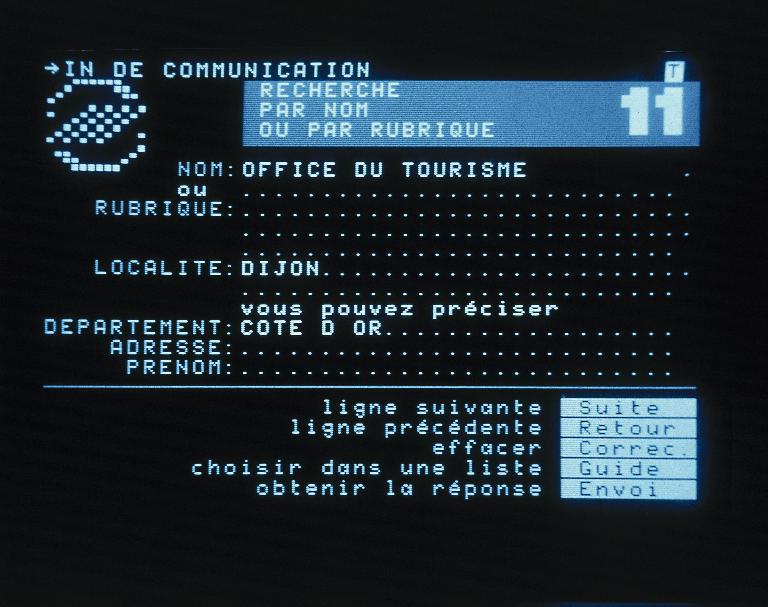
the Minitel.
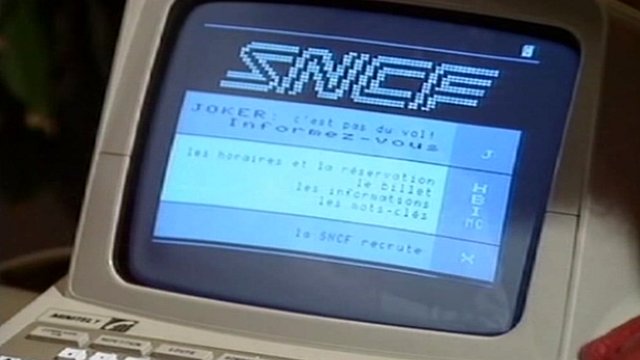
Introduction
The Minitel was a videotex online service accessible through telephone lines,
and was the world's most successful online service prior to the World Wide Web.
It was invented in Cesson-Sévigné, near Rennes in Brittany, France.
The service was rolled out experimentally on 15 July 1980 in Saint-Malo,
France, and from autumn 1980 in other areas, and introduced commercially throughout
France in 1982 by the PTT(Postes, Télégraphes et Téléphones; divided since 1991 between
France Télécom and La Poste). From its early days, users could make online purchases,
make train reservations, check stock prices, search the telephone directory, have a mail box,
and chat in a similar way to what is now made possible by the World Wide Web.
In February 2009, France Télécom indicated the Minitel network still had 10 million monthly connections.
France Télécom retired the service on 30 June 2012.
Officially TELETEL, the name Minitel is abbreviated from the French title of Médium interactif par
numérisation d'information téléphonique (Interactive medium for digitized information by telephone).
Minitel & the Internet.
The extent to which Minitel enhanced or hindered the development of the Internet in France is widely debated.
On the one hand, it included more than a thousand services, some of which predicted common applications on the modern Internet.
For example, in 1986, French university students coordinated a national strike using Minitel, demonstrating an early use of
digital communication devices for participatory technopolitical ends.[15] Alternatively, the French government's attachment to
the natively developed Minitel may have slowed the adoption of the Internet in France; in the 1990s there was a peak of nine million
terminals and there were still 810,000 terminals in the country in 2012. In the short term, some resources at France Telecom (now Orange)
were dedicated to the development of Minitel that might have otherwise been focused on Internet development. However, France Telecom's
focus on Minitel had little or no long-term effect on adoption or development of internet- and web-based companies in France; France ranks
roughly equal to the US and Germany in the current penetration of high-speed internet in households.
for more details:
Growth.
Canada.
Payment.
Hardware.